
Beyond "Click Here": 5 High-Converting CTA Strategies for B2B SaaS Blogs
Driving traffic to your B2B SaaS blog is the easy part. Writing a CTA that convinces founders to take action is where many SaaS companies miss the mark.
By Israel Usulor
Most B2B SaaS companies treat CTA as less important instead of giving it the kingly attention it deserves in a SaaS blog article. This is exactly why SaaS companies spend thousands of dollars on ads to rank first on Google, but their actual conversion rate is nothing to write home about. Thousands of readers visit the company’s blog, read articles, but fail to take positive action, which is to buy or sign up for a product.
A more common mistake SaaS blog writers make is to use generic CTAs such as “Click here", and “Learn more,” without actually pinpointing the benefit readers will get by taking the action. Worse still, these CTAs are buried at the bottom of a 2000-word article where the reader will see them only when they have passed the action point.
A high-converting CTA is actually simple and different. Great CTAs align with the reader’s intent and offer a clear benefit before asking for action. This is clearly different from the usual practice of pushing every visitor toward a demo request. This needs to change if you want results.
Here are five CTA strategies that consistently perform better for B2B SaaS blogs.
1. CTA Match Search Intent
Perhaps the most important thing to know is that not everyone visiting your SaaS blog wants to buy the product immediately. Not every blog visitor is ready to talk to sales as soon as they land on the page, so pushing them to take action at that point might not work.
A good example is a blog visitor who is reading "What is SOC 2?" It is most likely that this visitor is researching a problem and may not immediately be ready to book a demo. Compare that to someone reading "Best compliance software for startups.” This person is clearly looking for a product and is therefore much closer to making a purchase.
The takeaway here is that each call-to-action should match why the reader landed on the page. Asking a casual reader to ‘book a demo’ won’t work, but might work if the person landed on the page to read about a specific product.
A strong CTA matches search intent and is tailored for the blog visitor, not generic
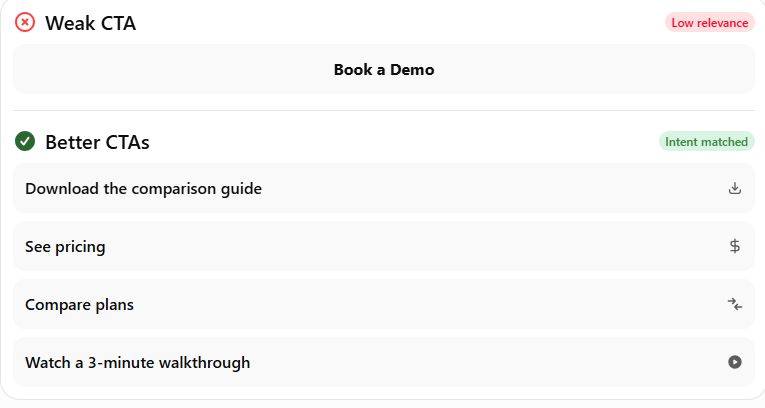
The most important question to answer while designing CTAs is “what does the reader want?” If the reader wants information, perhaps offering a resource could be the best CTA. But if the reader is evaluating a product, the CTA should offer a comparison, pricing page, or product tour.
2. Lead with Value, Not the Action
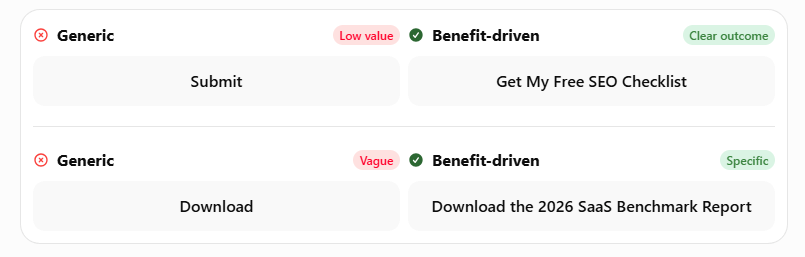
Most SaaS companies focus on telling the blog visitor what to do without first telling them the benefit of the action. Most CTAs fail to offer value; instead, they focus on generic persuasion that blog visitors find coercive and off-putting. The reader is asking “what value will I get from this?” But the CTA is saying “download, book a demo, submit, sign up” without highlighting value.
A great CTA factors in the fact that readers focus on the outcome. They want to know the benefit of the thing you are asking them to do.
CTA should draw attention to the benefit
3. Use Contextual CTAs Throughout the Article
One of the biggest mistakes SaaS companies make is to hide the CTA at the bottom of the article where the reader will see it after many minutes of reading. Sometimes, the reader doesn’t get to see the CTA because they stopped reading at the midpoint and then left the page. So the CTA failed not because it was not well-written, but because the reader didn’t even see it.
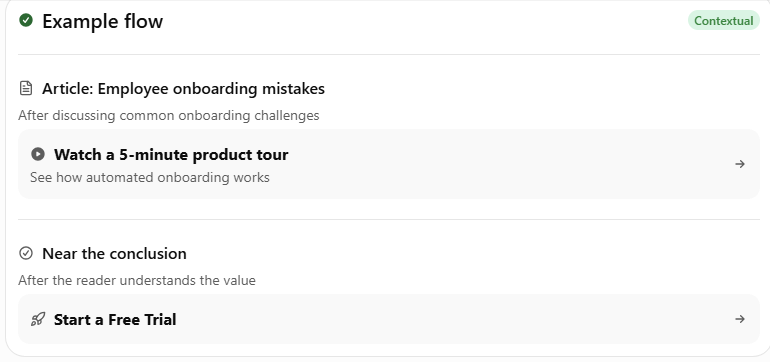
That’s why inline CTAs are crucial. At strategic points in the article, the reader should come across contextual CTAs. Put the CTA’s where they naturally fit and not at the bottom. The better approach is to usher in the CTA after explaining the problem a product could solve.
Introduce the CTA after explaining a solution a product could solve
4. Reduce Commitment Before Asking for a Demo
It is a mistake to start pressuring the reader to “book a demo” or “contact sales” as soon as they read the first sentence of the article. Most readers are just checking things out, and asking them to “book a demo” that early is likely going to feel like a high-commitment decision which they are not prepared for.
The solution is to immerse them in the product first. This should happen as early as possible in the article, so that they begin to understand the product and its benefits. Helping the reader understand the product through learning alternatives lowers friction.
Lower-friction alternatives include:
Watch a product tour
Try an interactive demo
Use a free calculator
Read a customer case study
Download a template
5. Test CTA Copy, Placement, and Design
While there is no universally perfect CTA. However, little, well-applied changes can go a long way in driving conversion rates. When building an intentional conversion path, context is everything. You have to evaluate:
The Framing: First-person vs. second-person copywriting hooks.
Placement: In-line text vs. traditional sidebar banners.
The timing: Intercepting a reader mid-article vs. waiting until the end of the post.
The design: Visual cues like color contrast and macro button placement.
Evaluating framing, placement, timing and design might seem unnecessary, but they matter to how the reader sees the product.
A quick CTA checklist
Before the publish button on your SaaS article, a quick check could help you make sure you have ticked all the necessary boxes.
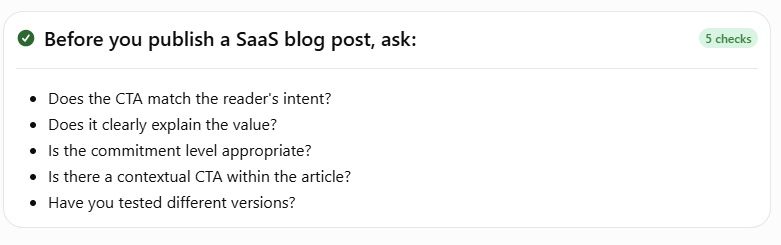
The greatest takeaway here is that high-converting SaaS CTAs are not the most persuasive; they are simply more relevant and tailored to what the blog visitor wants.
Indeed, most B2B companies that focus on conveying their value and how they solve users' needs have high conversion rates and spend less on advertising and ranking high on Google. Many of the services I've ended up buying or subscribing to are ones where I clearly understood the benefits and how they could actually address my need.